Rosario Islands from Cartagena: Speedboat, Catamaran or Party Boat?
Updated September 26, 2026 · 7 min read
Almost every island day out of Cartagena leaves from the same place: Muelle de la Bodeguita, the pier below the old town walls, which Colombia’s maritime authority Dimar designates as the authorised point for commercial passenger transport to the Rosario and San Bernardo archipelagos. Same pier, same islands, same morning. What differs is the hull you are standing on — and that decides almost everything about the day.
There are 127 island trips in our Cartagena listings, from €12.32. Here is how to tell them apart before you pay.
The crossing is the whole difference
The Rosario Islands are a coral archipelago roughly 35 km southwest of the city, inside the Corales del Rosario y San Bernardo national park. Everything else follows from that distance.
| Boat | Crossing to the first island | What the day feels like |
|---|---|---|
| Speedboat (lancha rápida) | 45 minutes to 1 hour | Fast, loud, bumpy, many stops |
| Catamaran | around 1 hour 15 minutes under sail and engine | Slow, level, one or two anchorages |
| Party boat | same as the speedboat | Music from the first minute |
The far end of the archipelago is further than people assume: reaching San Martín de Pajarales, where the Oceanario sits, can take up to an hour and fifty minutes each way. If a tour promises the aquarium and several beach stops and lunch, the arithmetic is tight, and what gets shortened is your time in the water.
The five-stop format is the default, and it is a lot of moving
The single most booked island day in the city is the five-stop Rosario Islands tour with lunch and beach clubs — €64, 4.6 stars, and more than 6,300 reviews, which makes it by a wide margin the most-reviewed activity in Cartagena. It runs six and a half to seven hours door to door.
Five stops in seven hours, minus roughly two hours of travelling, leaves something under an hour per stop. That is the honest maths, and it is not a criticism: the format exists because a lot of people want to see several islands rather than sit on one. But if your idea of an island day is a book and a hammock, this is the wrong boat, and the six-stop version with snorkelling and the aquarium at €65.84 is even more so.
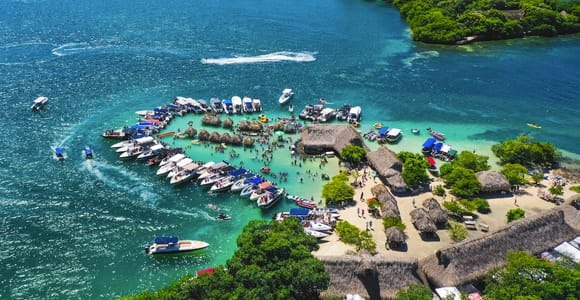
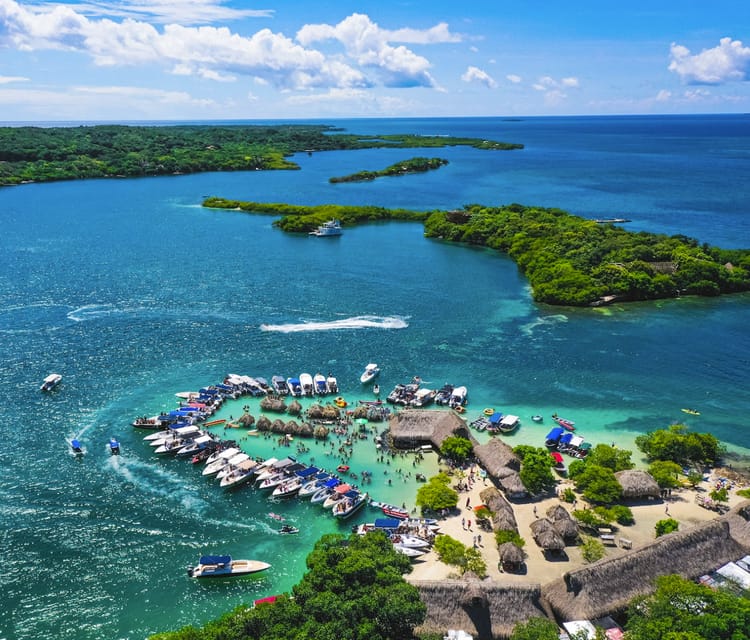
One of the “stops” on several of these itineraries is Cholón, a shallow bay off Barú where boats raft up in a horseshoe around floating bars and people stand waist-deep in the water with a drink. It is genuinely fun and it is emphatically not a quiet beach. Booking photographs rarely make the distinction.
The catamaran buys calm, not speed
The Rosario Islands catamaran with lunch and snorkelling costs €102 and runs seven and a half hours — more money and more time than the speedboat, for fewer islands.
What you get for that is the ride itself. A catamaran sits on two hulls and crosses the swell flat instead of slamming through it, which matters more than it sounds between December and March. It is also the only one of the three where the journey is part of the day rather than the price of admission.
If someone in your group is prone to seasickness, this is the boat, and the reasoning is simple hull shape rather than anything medicinal — anyone who normally takes something for it should sort that out with a pharmacy before the trip, not at the pier.
The fee you pay in cash, at the pier, on the day
This is the part that catches nearly everyone, because it appears on no booking confirmation.
Every passenger pays a pier and park charge in cash, in Colombian pesos, at La Bodeguita before boarding. It is not part of the tour price unless the operator says in writing that it is. Reported amounts in 2026 run at around COP 31,500 for the port fee plus roughly COP 8,800 for the compulsory insurance operators call seguro obligatorio; one Cartagena operator publishes a combined COP 41,000 covering pier, park entry and insurance together. The figure is set by official resolution and pier administration, so it moves — treat it as “about forty thousand pesos per person, in cash” and bring banknotes rather than a card.
Children pay it too. This is the single most common surprise on an island day, and it is the reason a family of four should walk to the pier with more cash than they think they need.
December to March: the sea has a vote
The dry season is the good season — January, February and March are the driest months of the year and the ones most people fly in for. They are also the months of the northeast trade winds, and those winds stir up the crossing.
What that means in practice:
- The ride out is rougher, and a speedboat feels it far more than a catamaran.
- Operators sometimes bring the return forward, because the swell builds through the afternoon. Your seven-hour day quietly becomes a six-hour one.
- In the strongest conditions, departures are suspended altogether. A perfect blue sky over the old town says nothing about what the water is doing 35 km offshore.
None of this makes the dry season a bad time to come. It makes an island day in February something to book early in your stay rather than on your last morning, so a cancelled sailing has somewhere to go.
So which one
- You want to see the archipelago and you have one day for it — the five-stop speedboat trip. It is the format the city is built around, and the review count is not an accident.
- You want the water rather than the itinerary — the catamaran, and accept the price.
- You are here with friends and the point is the day, not the islands — the five-stop party boat with lunch at €56.84, which is honest about what it is.
- You mainly want a beach — none of the above. Go to Playa Blanca on Barú instead, which is a different kind of day and a cheaper one.
Whichever you pick, departures from La Bodeguita run from around 8 am to 10 am, with returns from about 3 pm. There is no late boat. Miss the morning and you have lost the day.