The Walled City and Getsemaní on Foot: Which Guided Walk Is Worth It
Updated September 26, 2026 · 7 min read
The old town of Cartagena is small enough to cross in twenty minutes and dense enough to spend three days in. That combination is exactly why a guided walk here earns its money — not because you would get lost, but because without one you walk past the thing you came to see and photograph the wall next to it.
We list 92 old town and walking tours, from €9.54. They divide into three formats, and the ratings separate them more cleanly than the prices do.
The ratings say something the prices do not
Two of Cartagena’s most-booked city tours sit in our listings with very different scores:
| Price | Rating | Reviews | Length | |
|---|---|---|---|---|
| Historic centre and Getsemaní walking tour | €12.27 | 4.9 | 3,528 | 2.5 hours |
| Panoramic city tour: monuments, walls, castle | €23.72 | 3.8 | 1,008 | 4 hours |
Both have over a thousand reviews, so neither score is a fluke. The walking tour is the second-most-reviewed activity in the whole city, behind only the big island day — and at 4.9 it is rated higher than anything else near its volume.
The gap is about format, not about guides. A four-hour panoramic tour spends a large part of those four hours in a vehicle getting between the walls, La Popa and the castle, in a city whose traffic is slow and whose afternoons are hot. A two-and-a-half-hour walk through the walled city and Getsemaní never gets into a vehicle at all. One of those formats disappoints people reliably; the other does not.
That is not an argument against ever taking the panoramic tour. It is an argument for knowing what you are buying: if the point is the fortifications and the hilltop view, take a tour built around exactly those two rather than a circuit that includes them.
“Free tour” and “shared tour” are not the same thing
Cartagena’s walking-tour market runs two formats side by side, and the same operators often run both.
A shared tour is booked in advance for a fixed price — the €12.27 above is the price, not a deposit. A free tour gathers at a fixed square at a fixed time, costs nothing to join, and ends with the guide explaining that the guide is paid by tips. Both are legitimate. What is not legitimate is being unclear about which one you joined.
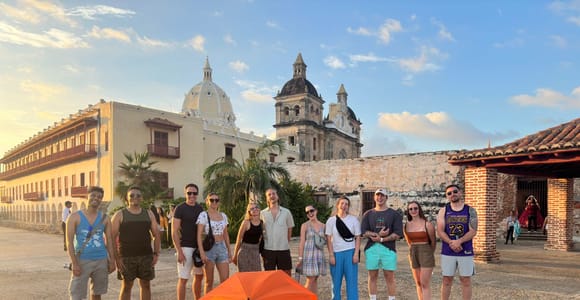
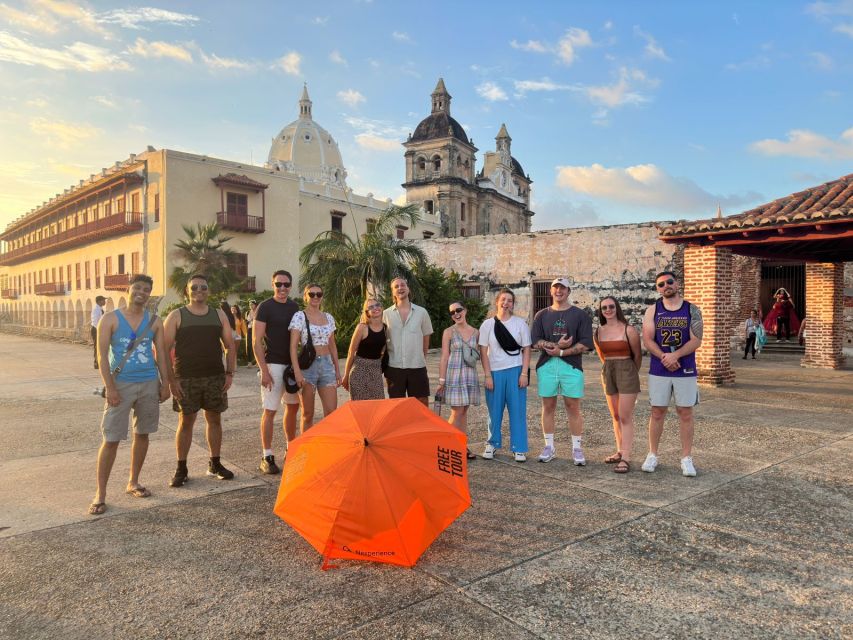
The tell is visual and slightly comic: the cover photograph of that 4.9-rated shared walk shows the group standing behind a bright orange umbrella with FREE TOUR printed on it. The umbrella is the operator’s meeting marker across both products. If you have booked and paid, say so at the meeting point and check the guide’s list — otherwise you can end up in the tip circle at the end of a walk you already paid for.
What a good walk actually covers
The two neighbourhoods are a twelve-minute walk apart and feel like different cities.
- Inside the walls — the plazas, the cathedral, San Pedro Claver with its dome and bell tower, the balconies, and the sections of rampart you can walk along. This is the postcard, and it is also where the guide’s commentary matters most: the buildings are handsome and mute without it.
- Getsemaní — outside the main wall, the old working quarter, now the city’s mural district. Plaza de la Trinidad is its living room: the square fills in the early evening with people eating from carts, and a guide who takes you there at the right hour is doing you a bigger favour than one who shows you another church.
- Las Bóvedas — the vaulted casemates at the northern end of the walls, today souvenir shops. Worth knowing before you form an opinion of the prices: the Bóvedas are part of the fortification complex formally administered by the ETCAR, the same body that runs Castillo San Felipe, and not a market that grew there by itself.
A tour that covers the walls and Getsemaní in two and a half hours is walking briskly. A tour that promises the walls, Getsemaní, the castle and La Popa in four is mostly promising a minibus.
Start late, not early
This is the single most useful practical decision, and it has nothing to do with which operator you pick.
Cartagena sits at ten degrees north, which means the sun is nearly overhead at midday all year and the day length barely moves. Sunset shifts by only 52 minutes across the entire year — from 5:37 pm at its earliest, on 16 November, to 6:29 pm at its latest, on 11 July.
Two consequences:
- A midday walking tour is a genuinely hard two hours. There is very little shade in the plazas and none on the ramparts. A late-afternoon start is not a nice-to-have.
- The same 4 pm start ends in very different light depending on the month. In July you finish comfortably before dark. In November the sun is down before 5:40 pm, so the last part of a 4 pm walk happens in dusk and then in streetlight — which is atmospheric on the walls and less useful for seeing murals in Getsemaní.
If you want the murals, go in daylight. If you want the ramparts, go at the end of the day. They are not the same outing, and trying to get both from one two-and-a-half-hour slot is how people end up disappointed with a 4.9-rated tour.
Two honest warnings
The heat is the reason most complaints exist. Before you blame a guide, check what you booked: a four-hour outdoor tour starting at 11 am in Cartagena would be a demanding morning anywhere on the Caribbean coast.
A walk is not a fortification ticket. If your tour includes Castillo San Felipe, someone is paying the entrance fee, and it is worth checking in writing whether that someone is you — the castle’s full rate is set by official resolution and is not small. That is covered separately in our piece on the castle and La Popa.
And if you have only one morning and one afternoon in the city: the walk is the afternoon. The morning belongs to the boat, because there is no late one.